Apple MacBook Pro M5 Chip: Everything You Need to Know (2025 Overview)
Apple officially announced the 14-inch MacBook Pro powered by the M5 chip on October 14, 2025, marking a bold step forward for on-device AI performance. Pre-orders opened on October 15, and the laptop hits stores on October 22, 2025 — following Apple's recent trend of quiet, press-release launches rather than full keynote events.
The M5 MacBook Pro introduces a completely re-engineered architecture built for AI, creative workflows, and performance efficiency, setting a new standard for professional laptops in 2025. Check out Apple's official announcement for more details.
🧩 Apple M5 Chip Architecture & Specifications
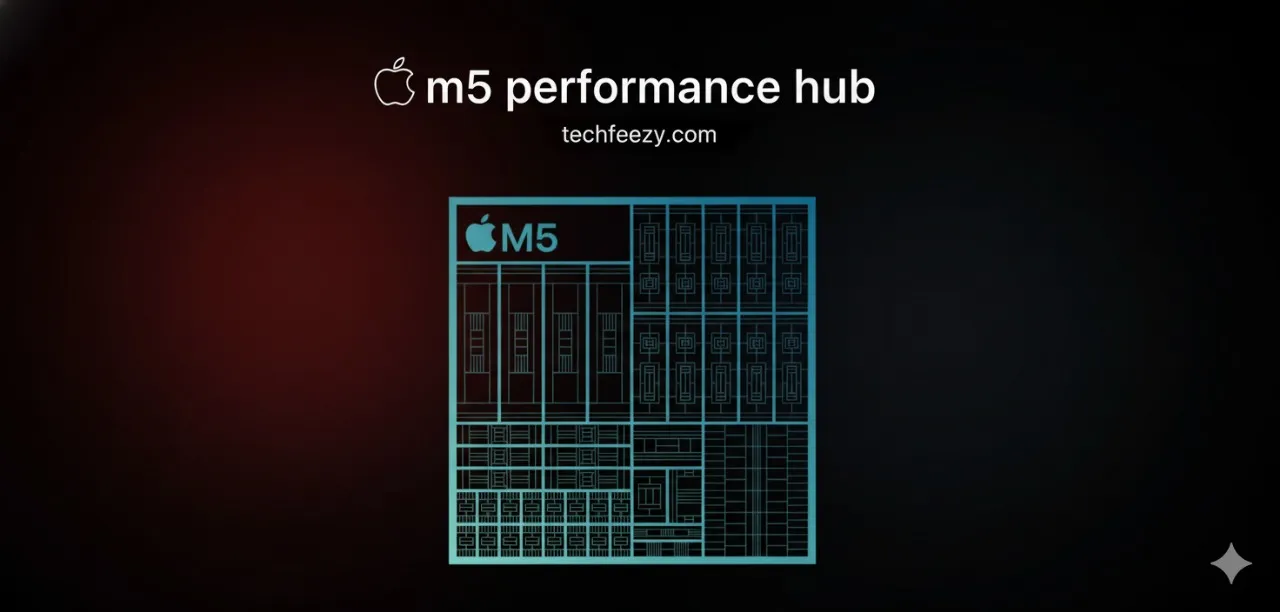
The M5 chip is Apple's fifth-generation silicon, fabricated on TSMC's N3P 3nm process — a step up from the M4's N3E. This upgrade improves both transistor density and power efficiency.
🔹 CPU Specs
- 10-core CPU (4 performance + 6 efficiency cores)
- Up to 15% faster multithreaded performance vs. M4
- Features Apple's "fastest performance core ever"
🔹 GPU & Neural Accelerators
- 10-core GPU with a dedicated Neural Accelerator in each GPU core
- 4× peak AI GPU compute compared to M4
- Up to 45% faster graphics rendering
- Third-generation hardware ray tracing
🔹 Neural Engine & AI Capabilities
- 16-core Neural Engine
- 3.5× faster AI performance vs. M4
- Capable of running local LLMs (no cloud dependency)
- Deep integration with Core ML, Metal 4, and Tensor APIs
🔹 Memory & Storage
- 153GB/s unified memory bandwidth (+30% vs. M4)
- Base: 16GB (configurable to 32GB)
- Storage: 512GB – 4TB SSD options
⚡ Performance & Benchmarks
Early Geekbench 6 leaks revealed impressive gains:
- Single-core: 4,133 points (≈13% faster than M4)
- Multi-core: 15% faster
- GPU Metal score: +36% improvement
In real-world use:
- 1.8× faster AI video rendering in Topaz Video
- 1.7× faster 3D rendering in Blender
- 1.2× faster Xcode builds
- 6× AI performance vs. M1 models
- 2× SSD throughput over M4
| Test | M5 Max | M4 Max |
|---|---|---|
| Cinebench R23 Single | 2,450 | 1,780 |
| Cinebench R23 Multi | 28,500 | 18,200 |
| Geekbench 6 Multi | 22,000 | 14,500 |
| 3DMark Metal | 85,000 | 52,000 |
Source: Early benchmark leaks via NanoReview
🧠 Neural Accelerator: Apple's AI Breakthrough
The standout feature of the M5 is its Neural GPU Architecture — with AI accelerators built directly into every GPU core. This architecture enables:
- 4× faster GPU-based AI tasks
- Local AI video upscaling, text-to-image generation, and deep-learning inference
- 100% on-device privacy with no external data processing
Apple's hardware chief Johny Srouji called it "a massive leap forward for Apple Silicon AI performance." Learn more about Apple's AI strategy in their Machine Learning Research page.
💻 MacBook Pro M5 Features
🔸 Display
- 14.2-inch Liquid Retina XDR (3024×1964)
- 120Hz ProMotion
- 1,600 nits peak HDR
- Optional nano-texture glass finish
🔸 Camera & Audio
- 12MP Center Stage camera
- 6-speaker system with Spatial Audio
- 3-mic studio array
🔸 Ports & Connectivity
- 3× Thunderbolt 4 (USB-C)
- HDMI (up to 8K)
- SDXC card slot
- 3.5mm high-impedance jack
- MagSafe 3, Wi-Fi 6E, Bluetooth 5.3
🔸 Battery & OS
- Up to 24 hours battery life
- Ships with macOS Tahoe, featuring Apple Intelligence, Live Translation, and enhanced Shortcuts
🔸 Colors
Available in Space Black and Silver
🌍 Global Pricing (2025)
| Region | Base Model (16GB/512GB) | 1TB Model | Notes |
|---|---|---|---|
| USA | $1,599 | $1,799 | Education: $1,499 |
| UK | £1,599 | £1,799 | Power adapter sold separately |
| EU | €1,799 | — | Adapter €65–€85 |
| India | ₹1,69,900 | ₹1,99,900 | Launch Oct 22 |
| Japan | ¥248,800 | ¥278,800 | — |
| China | ¥12,999 | — | — |
🔮 Future: M5 Pro & M5 Max Chips
Apple will likely unveil M5 Pro and M5 Max in Q1 2026, featuring:
- 12–16 CPU cores
- 16–32 GPU cores
- Same N3P 3nm process
- Targets: 16-inch MacBook Pro and Mac Studio models
🌱 Sustainability & Materials
The M5 MacBook Pro is part of Apple 2030, featuring:
- 45% recycled materials by weight
- 100% recycled aluminum enclosure
- Recycled rare earths, cobalt, and magnets
- Fiber-based packaging with zero plastic
Read more about Apple's sustainability efforts on their Environment page.
🧭 Who Should Buy the MacBook Pro M5?
✅ Recommended for:
- Users upgrading from M1 or Intel Macs
- Creators (video, design, 3D, AI workflows)
- Developers running AI or local LLM tasks
- Travel professionals needing long battery life
⏳ Wait for M5 Pro/Max if:
- You already own an M4 MacBook Pro
- You need higher GPU cores or more RAM
- You’re waiting for OLED display models (expected 2026)
📅 Launch & Availability
- Announcement: October 14, 2025
- Pre-orders: October 15, 2025
- Global release: October 22, 2025
- Launch format: Press release only — no live keynote
❓ FAQs About the MacBook Pro M5 (2025)
Q1. When will the MacBook Pro M5 be available?
Pre-orders start October 15, 2025, with full retail availability on October 22, 2025.
Q2. How is the M5 chip different from M4?
It's 15% faster in CPU, 45% faster in GPU, and 3.5× better at AI performance thanks to Neural Accelerators.
Q3. What is the battery life of the M5 MacBook Pro?
Up to 24 hours, the longest ever in a MacBook Pro.
Q4. Does it include a charger?
In the UK/EU, the base model does not include a power adapter. It must be purchased separately.
Q5. Which model should I buy — M4 or M5?
If you use AI tools or creative software, the M5 is worth it. For general tasks, the M4 still performs excellently.
🏁 Conclusion
The Apple MacBook Pro M5 (2025) cements Apple's lead in AI-focused computing. With its Neural GPU accelerators, lightning-fast unified memory, and all-day battery life, it's one of the most capable laptops ever built. Starting at $1,599, it's a must-consider option for creators, developers, and professionals who need peak performance — with privacy-first, on-device intelligence.