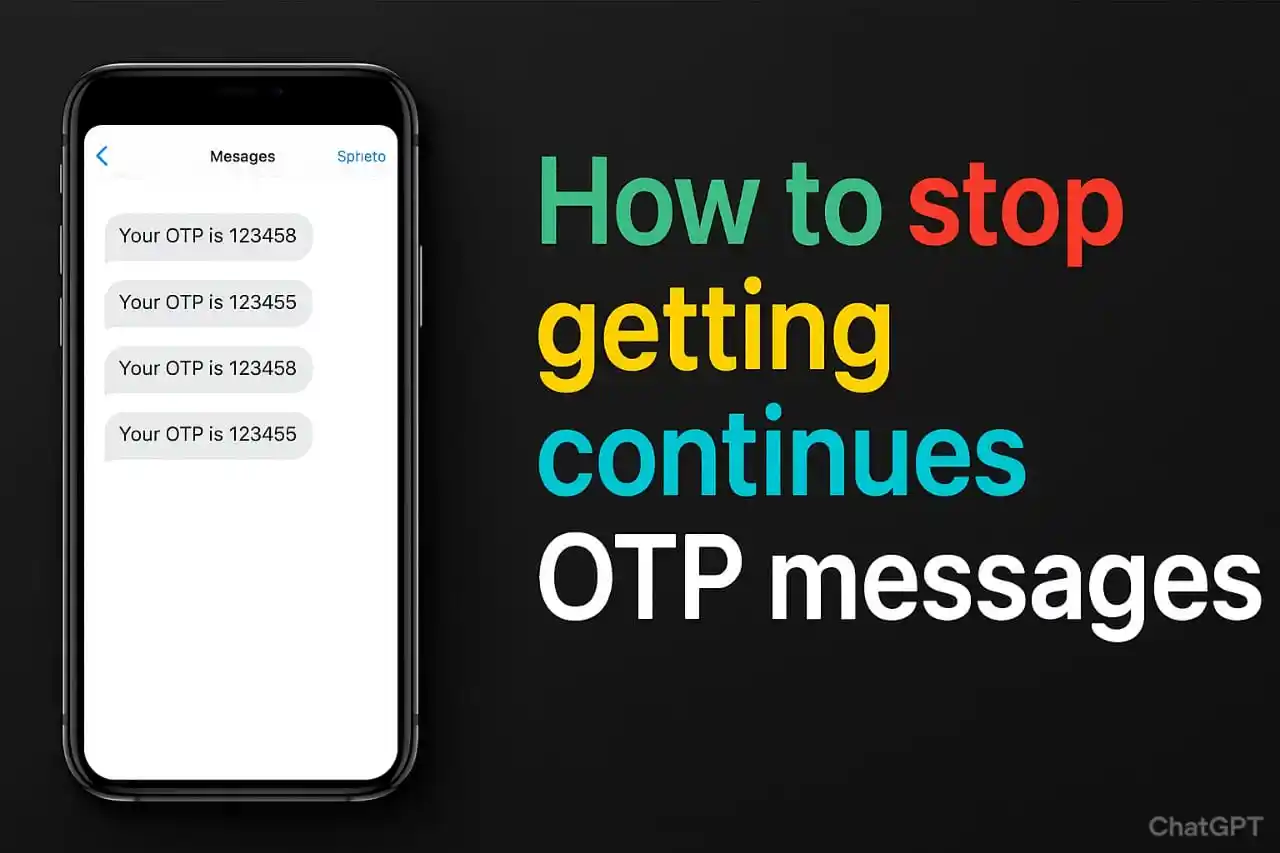
Regardless if the messages are from the same business or from any other unknown service providers, the constant OTP messages can be extremely annoying and, more importantly, can cause concern. It's more than a spam attack, it can be a major security issue when many of our messages are cluttered. No one wants their inbox overflowing. In this case I will provide you the practical steps that will help you to prevent these constant OTP messages.
Why Do I Receive An Abundance of OTP Messages?
On a completely different note, receiving these unsolicited messages is no longer a matter of significance if it is a mere annoyance, considering these can also pose security issues. There could be many reasons for receiving these messages:
- Phishing attempts: Sending the message with the one-time password attempts is a mechanism of a scam to beep personal info.
- Sim swap attack: Be it yourself or any third party, the phone number control is with the fraudsters and the sets of One Time Passwords are intercepted.
- Data collecting: There is a high possibility your number is circulated and harvested.
- Accidental Registration: Take for example a sign up service, your number could have been used randomly and a registration was inadvertently agreed to by clicking on sign up.
Instructions to Take in Order to Stop Receiving OTP Messages Continuously

1. Block the messages from particular Senders
Most smartphones have the option to report the messages as spam, or to block the number entirely. Here is the process to do so:
For Android:
- Open the text messages thread.
- Click on the three dots option on the upper right.
- Select “Block Number” or “Spam”.
For iPhone:
- Open the text
- Click on the contact at the top
- Select “Info” and “Block this Caller.”
Blocking specific numbers will definitely lower the amount of OTP messages of unknown origins that will arrive.
2. Enroll with the National Do Not Disturb (DND) Service
Inside India, the Telecom Regulator of India (TRAI) provides a National Do Not Disturb (DND) service to minimize the unwanted commercial messaging.
To turn on DND:
- Text the number 1909 with the message START 0.
- To set up different limits:
- Text the number 1909 with the message START 1 and enable full DND.
- Text the number 1909 with the message START 2 to only block the commercial messages.
DND will reduce the amount of promotional OTP messages received greatly.
External Resource: Learn more about DND at TRAI’s official website.
3. Get in Touch With the Customer Support of the Service Provider
If you get OTPs from a service such as Meesho, Flipkart, or Jio, you should consider reaching out to their customer service.
- Tell Them the Issue: Explain to them that you are receiving an excessive number of OTP messages when you did not request them.
- Request for Deactivation: Ask the representative to disable OTPs for your number.
Most well-known service providers will be able to assist you in blocking spam messages of OTPs.
4. Protect Your Phone Number
To avoid receiving OTP spam in the future, try the following steps:
- Publicly Avoid Cell Number Exposure: be careful about the sites you provide your phone number to.
- Use a Burner Phone Number: for one-off verifications, consider the possibility of using a one-time disposable phone number.
- Educate Yourself on Phishing: be trained to recognize attempts made by technology to trick you into giving out your one-time passwords.
External Resource: For burner number services, check Burner.
What Is OTP Bombing and How Does It Affect You?

Even though it appears to be random spam, OTP bombing is not. It is an attack in which a phone number is bombarded with hundreds, or even thousands of, one-time passwords in a very short amount of time. It is a malicious act in which the services that rely on OTPs are used to pour spam into the inbox, and in some cases, slow down the phone, to the extent that the phone or the inbox is unable to receive real OTPs. It is an attempt to bomb the phone with OTPs.
Here’s how OTP bombing works:
- Targeting Phone Numbers: Attackers locate and guess phone numbers, and input them into websites and apps that send OTP texts.
- Automated Requests: Attackers use bots that send repeated requests for OTPs from numerous services to completely flood an assigned number.
- Disruption: Attackers bombard the assigned number's inbox with multiple OTP messages and the Target does not receive important OTP texts when needed.
- Security Risks: In the context of OTP bombing, it is done as a disguise to hide other forms of phishing that are easier to detect, like hijacking or SIM swap attacks.
How to Protect Yourself From OTP Bombing:
- Spam Reports are Effective: Capture and Mark the OTP texts as spam or send them to your service provider.
- Notification Alerts: Some services notify their users when some suspicious activity is detected regarding their phone numbers.
- Two Step Verification: Use two-step verification (or 2FA) with caution, do not transfer back up access codes and your email accounts need to be protected.
- Enhanced Security Procedures: Update your passwords often and use apps with stronger security measures.
- Use Separate Numbers: For services with numerous OTP requests, consider avoiding or using a separate number.
Additional Tips to Improve Your Security

- Two Factor Authentication(2FA): adds an additional layer of security so it is recommended to use it whenever available.
- Create Unique Passwords: Each of your accounts needs to have its own strong, different password to avoid any unauthorized people gaining access.
- Check Account Statements: Review your bank and other accounts weekly to search for anything unusual.
Advantages and disadvantages of disabling OTP texts

| Advantages | Disadvantages |
|---|---|
| Reduction of external annoyance | Legitimate OTPs from services might be missed |
| Phishing attacks can be avoided | Some services might need OTPs for tiers of access |
| Uplifting phone security | Legitimate services can be affected from blocking too many numbers |
Responding to Common Questions

Q1: Why do I get OTPs for services I haven’t requested?
A1: Receiving OTPs for services that were never requested could be due to phishing, swapping your SIM for a different one, or misuse of your phone number for registration.
Q2: I wish to block OTPs from a certain service, how can I go about it?
A2: It can be done by getting in touch with customer support of that service to request that OTPs be deactivated for your phone number.
Q3: Activating DND, will that supress all OTPs sent to me?
A3: DND will suppress promotional messages, but will still receive OTPs sent to you for transactions.
Q4: Am I at any risk by sharing my OTP?
A4: Yes, you are at risk and it will always be the case if you share your OTP with anyone, even people claiming to be from an official service. Revealing your OTP puts your accounts in a situation of internal unauthorized dealings.
Q5: What should I do if I keep getting the same OTPs over and over and over again?
A5: Reach out to your service provider and also use the DND (Do Not Disturb) service to block any unwanted messages.
Conclusion

Continuous OTP messages without any value should also serve as a notice worthy of red flags. This guide has the strategies on how to minimize and or eliminate the chances of receiving unending OTP messages and in return help you in securing your personal information. Always keep your guard up and limit your exposure as much as possible.
Contact your service provider and/or a cyber specialist if these problems continue or if you need any help.