What Is Generative AI?
Generative AI is a cutting-edge type of artificial intelligence that is changing the way computers work with human creativity. While older AI mainly analyzes data and makes predictions, generative AI is all about making brand-new original content. Whether it's a short story, a digital painting, a music track, or a video clip, this tech can produce it.
By using sophisticated machine learning and neural networks, generative AI creates outputs that feel surprisingly human. Its core mission is simple yet powerful: to boost what people can do, to handle tough jobs without direct supervision, and to spark new ideas that fuel progress in fields as varied as health care, finance, entertainment, and education.
Generative AI stands out because it scans piles of existing data to spot patterns and then creates entirely new—and still relevant—output. A great illustration of this is ChatGPT, which spins text, and DALL-E, which paints pictures. Both have shown that a computer can craft things that look and sound just like they came from a human.
This talent speeds up work and sparks fresh creative ideas, pushing efficiency to new heights. As tools like these keep growing smarter, they're set to upend entire industries and everyday tasks, so catching up with or guiding their development is now a must for software builders, companies, and policymakers.
How Generative AI Works
Generative AI is built on powerful computer tools called neural networks, which mimic how our brains work. These networks have many layers of tiny processing units, all connected to one another, letting them study huge data sets and find hidden shapes and trends.
Models like Generative Adversarial Networks (GANs) and Variational Autoencoders (VAEs) then take these trends and use them to invent fresh content that looks and feels like the original data. With GANs, two networks talk back and forth: one called the generator makes new examples, and the other, the discriminator, checks if they seem "real."
When the discriminator catches weak fakes, the generator fixes what's wrong, so both sides learn and improve over time, pushing the quality of the new content higher with every round.
The cycle kicks off with what we call training data. This includes all kinds of resources—text collections, photo libraries, and audio clips, to name a few. While training, the model figures out the hidden rules inside this data, and then it can invent new content that looks and sounds just like it's from the same family.
Picture a model that listens to years of classical music. Once it's trained, it can write new melodies that any classical fan would swear were penned by a human composer. This knack for absorbing existing material and then spinning out fresh, well-organized ideas is the secret sauce that makes generative AI different from other AI systems.
Plus, the latest developments in transformer models, such as Google's Gemini and OpenAI's GPT-4, let these systems combine text, photos, and sound all in one go, resulting in creations that are smarter and more polished than ever.
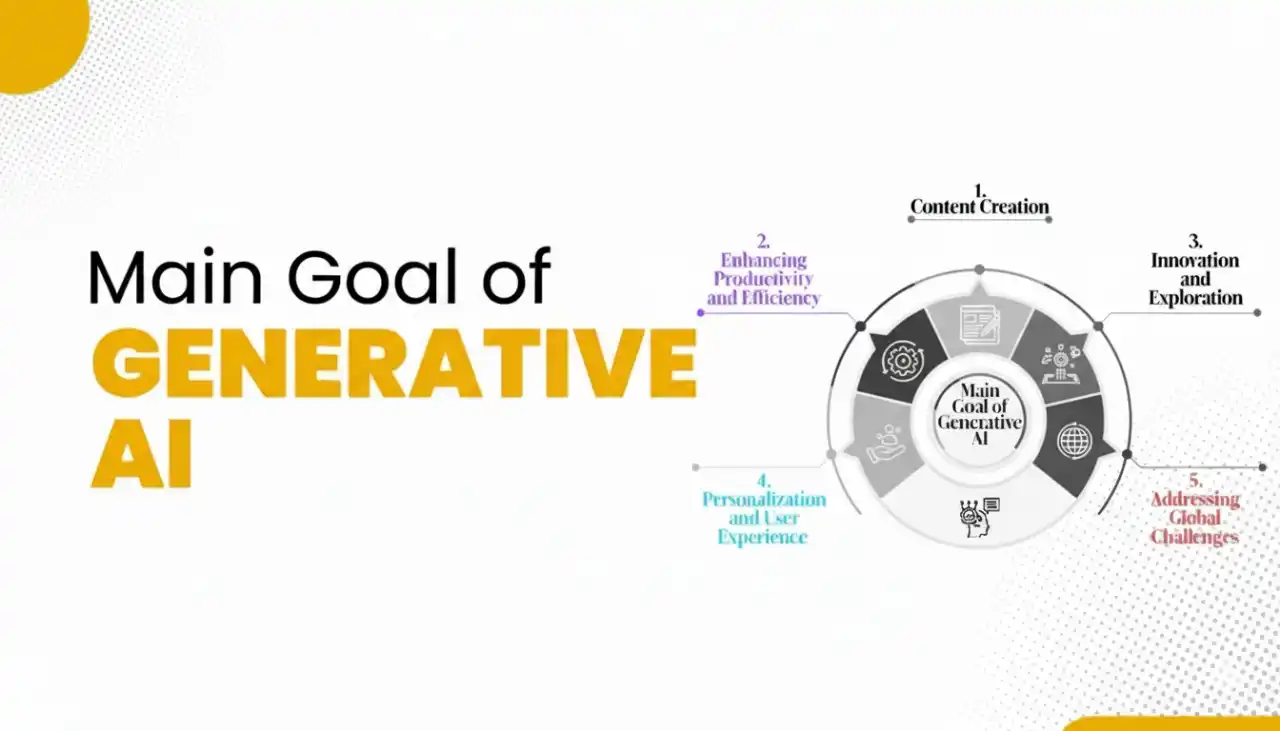
The Primary Goals of Generative AI
Content Creation and Automation
One major goal of generative AI is to speed up and boost content creation. This means automatically making text, images, audio, and video that feel real, stay on topic, and are high in quality.
Companies, for example, turn to AI to write ad copy, create graphics, and even score music. This saves a lot of time and cuts costs. The AI looks for patterns in existing data and then crafts AI-generated content that clicks with people, making it easy to produce large volumes of the same quality.
Augmenting Human Creativity and Speeding Up Work
Generative AI doesn't intend to take over human creativity; it wants to lift it. Think of it as a co-author that suggests ideas, quickens brainstorming, and takes care of busy-work. Because of that, people can give more energy to big-picture thinking and imagination.
For instance, programmers now lean on AI to write the simple lines of code that usually slow them down, speeding up the whole software build while keeping the code tidy. In the arts, musicians, painters, and writers feed their tools early sketches of concepts, revealing hidden styles and fresh approaches.
Together, people and machines push traditional boundaries, making productivity and fresh ideas the everyday norm rather than the exception.
Tackling Today's Toughest Problems
Generative AI sets its sights on the real-world puzzles that need clever teamwork. In health care, it designs new molecules to help scientists invent the next miracle drug.
When researchers want to know how climate change might shift ocean circulation, AI spins detailed future weather maps, letting them test green ideas before the real oceans drift. And when patient data is thin or sensitive, the same systems can invent convincing mock data to teach other AIs the same way real records would, protecting privacy and making models stronger.
By filling those gaps thoughtfully, AI not only boosts existing knowledge but also shores up the ethics that keep scientists and society aligned.
| Goal | Description | Example Applications |
|---|---|---|
| Content Creation | Generating text, images, audio, and video to help creative teams finish projects faster and easier. | Marketing copy, design visuals, music tracks. |
| Human Augmentation | Supporting human teams by automating dull work and suggesting fresh ideas. | Autocomplete code, brainstorm with artists, list new concepts. |
| Problem-Solving | Solving tough problems in health, the planet, and education with simulated datasets and models. | Speeding up drug design, predicting climate trends, creating sample research data. |
Real-World Applications of Generative AI
Content Creation and Marketing
Generative AI is changing how companies produce content by letting them make high-quality text, images, audio, and video in bulk. Fast-food chains like Wendy's and Papa John's, for example, already use it to customize marketing campaigns and boost customer engagement without adding to their teams.
Designers now work faster, thanks to tools like DALL-E and Midjourney, which turn simple text prompts into eye-catching visuals, chopping design time and costs. On the marketing front, blogs, social posts, and product scripts generated by AI keep brands sounding like themselves and free human experts to tackle bigger ideas.
Customer Support and Personalization
Generative AI is changing customer support by bringing to life AI-driven chatbots and virtual assistants that respond instantly and with a personal touch. These systems use natural language processing to grasp what a customer is saying and then create replies that sound like they were written by a person. This boosts customer satisfaction.
Companies like Citi and Deutsche Bank have successfully deployed AI chatbots to answer questions and spot fraud on the spot. Beyond chatbots, generative AI dives even deeper into personalization. It studies a person's online habits and delivers customized product suggestions in fields like online shopping, streaming services, and even patient care.
Healthcare and Scientific Research
Generative AI keeps popping up in healthcare and is speeding up drug discovery, medical imaging, and individual care plans. Super-smart models that learn from biological data can create brand-new protein sequences that scientists can use to design medicines, saving both time and cash compared to the old methods.
In the world of medical imaging, AI makes fake data that researchers can use to teach their diagnostic systems; this boosts accuracy and keeps real patient data safe. For instance, radiology teams at Apollo and AIIMS hospitals have begun using generative AI to study scans and quickly produce diagnostic reports, making care faster and helping doctors focus more on their patients.
Benefits of Generative AI
Generative AI is changing the way we work, learn, and create. The first big benefit is boosting productivity. By handling everyday tasks like data entry and report draft creation, AI frees humans to tackle more meaningful work. Research found that developers using AI tools finish projects 25 to 30 percent faster on schedule.
The second benefit is personalized experiences. Generative AI customizes everything from online ads to medical education. Imagine a classroom where the AI instantly generates lessons that match each student's level. The result? Better understanding and higher test scores.
Generative AI also sparks innovation. Designers can quickly test a thousand color palettes, and scientists can simulate a new drug's effect overnight. In both cases, ideas that once took weeks to visualize can now be generated in minutes.
There's a fourth benefit: equal access to creation. Someone with no coding knowledge can now create a budget tracker app just by describing it. The same is true for custom album covers, choreographed dances, and 3D-printed toys. Even a notebook sketch can be turned into a full comic.
Finally, ethical concerns are real. We must address bias in data, protect intellectual property, and lessen energy use to enjoy these rewards responsibly.
Challenges and Ethical Considerations
Even with its promise, generative AI faces serious hurdles that must be addressed. First is bias in training data. When the information used to teach an AI is one-sided, the resulting text, images, or speech can solidify stereotypes or leave entire communities out.
Second is intellectual property infringement. If an AI studies copyrighted books, music, or art without the owners' consent, its creations can illegally mirror or adapt that work. That can lead to costly lawsuits and damage reputations.
Another major issue is hallucinations. These are fake but convincing facts that an AI might generate, which can be dangerous in fields like medicine or finance where accuracy is critical. An incorrect diagnosis or investment advice can have serious consequences.
Scientists and developers are also looking closely at the environmental cost. Training massive models can consume enormous amounts of energy, raising questions about sustainability. To tackle all of this, organizations need strict rules like human review of AI output, a commitment to varied training inputs, and clear disclosures about how models work and what decisions they influence.
The Future of Generative AI
The coming years for generative AI look more promising than ever. Up-and-coming multimodal models will blend text, images, sound, and video into one smooth interaction, letting creators build richer, more engaging experiences.
Right now, models like GPT-4o and Google Gemini can already edit words, pictures, and voice in one go. Plus, tighter model efficiency means cheaper power bills and a smaller carbon footprint, so more people will get to use these tools.
The spotlight is also shifting to ethical AI design. Developers now spend real effort cutting down bias, explaining model choices, and treating every user fairly. Lawmakers and firms are drafting rules to guard copyrights and privacy.
In the end, generative AI will keep growing into the ultimate team player, helping us dream bigger, invent faster, and solve everything from climate change to medical records.
Conclusion
Generative AI is changing the way we think about creativity, getting things done, and finding solutions. Their main job is to come up with fresh, original work that boosts what people can do. Industries like healthcare, finance, and entertainment are already seeing the change.
By using neural networks and machine learning, these models can produce text, images, audio, and video that are not only interesting but useful, too.
To unlock ALL that potential, we still need to tackle issues like bias, who owns the work, and how to be kind to the planet. The way ahead depends on people teaming up with these intelligent systems so we take the good stuff and share it fairly.
If you run a company, write software, or produce art, knowing the ins and outs of generative AI isn't just helpful. It's necessary for steering through the tech future that's already on its way.